
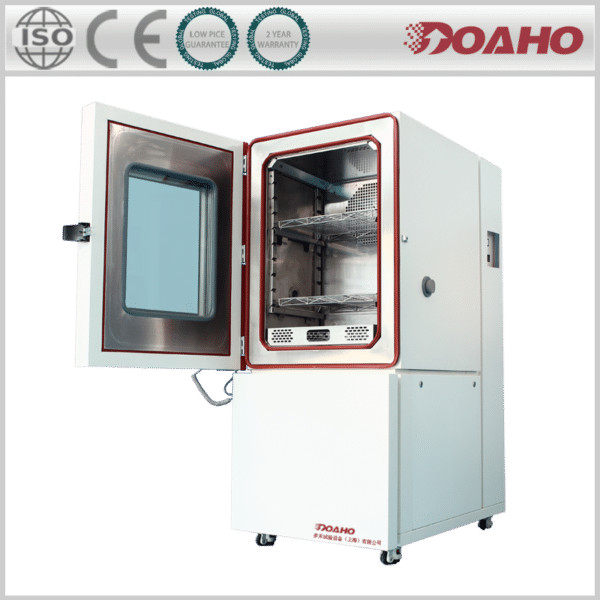
As global industries face escalating demands for product durability and regulatory compliance, environmental test chambers have become indispensable tools for validating performance under extreme conditions. These chambers simulate temperature fluctuations, humidity, vibration, and corrosion, enabling manufacturers to predict failures, optimize designs, and meet international standards. Leading this transformative field is Doaho, a top-tier environmental test chamber China manufacturer renowned for its precision engineering and AI-driven testing solutions. This article delves into the technology’s evolution, sector-specific applications, and Doaho’s role in shaping global quality assurance practices.
What is an Environmental Test Chamber?
An environmental test chamber is a controlled enclosure that replicates harsh environmental conditions to test product resilience. Key types include:
– Temperature and Humidity Test Chambers: Simulate ranges from -70°C to +180°C and 10% to 98% RH.
– Vibration Test Chambers: Mimic seismic activity or transportation stresses with programmable frequencies up to 3,000 Hz.
– Salt Spray Chambers: Assess corrosion resistance per ASTM B117 standards.
– Altitude Chambers: Test aerospace components under low-pressure conditions (up to 100,000 feet).
2025 Environmental Test Chamber Advancements:
– AI-Powered Predictive Analytics: Algorithms forecast failure points using real-time data.
– Multi-Stress Testing: Simultaneous application of temperature, humidity, and vibration.
Why Environmental Testing is Non-Negotiable in 2025
a) Regulatory Compliance
– Automotive: Must comply with ISO 16750 (electrical/electronic component testing).
– Medical Devices: FDA mandates ASTM F1980 accelerated aging tests.
– Electronics: IEC 60068 standards for consumer gadgets.
b) Cost Savings
– Early detection of design flaws reduces recalls by 60% (McKinsey, 2024).
– Extends product lifespan by 30–50%, enhancing brand reputation.
c) Sustainability
– Identifies energy-efficient materials and reduces waste via optimized prototyping.
Environmental Test Chamber Industry-Specific Applications
– Automotive: Battery testing for EVs under extreme temperatures (-40°C to +85°C).
– Aerospace: Validating satellite components in vacuum conditions.
– Electronics: Ensuring smartphones withstand tropical humidity and desert heat.
– Pharmaceuticals: Stability testing for vaccines in WHO-recommended environments.
Selecting the Right Environmental Test Chamber: 4 Key Criteria
1. Testing Scope: Match chamber specs to your product’s operational environment (e.g., Arctic cold vs. desert heat).
2. Scalability: Modular designs for future upgrades (e.g., adding vibration to thermal tests).
3. Data Accuracy: Ensure ±0.5°C temperature control and ±2% RH humidity precision.
4. After-Sales Support: Prioritize manufacturers offering calibration services and 24/7 tech support.
Doaho: Redefining Environmental Test Chamber Excellence
Founded in 2005, Doaho has delivered 15,000+ test chambers across 40 countries, cementing its status as China’s foremost innovator:
a) Core Technologies
– HyperCool™ Systems: Achieve rapid temperature transitions (15°C/min) with ±0.1°C accuracy.
– 3D Vibration Simulation: 6-axis shakers replicate real-world dynamics for automotive and defense sectors.
– Smart Chamber OS: IoT-enabled control panels with remote monitoring via mobile apps.
b) Certifications & Partnerships
– Compliant with CE, UL, and GB/T 10586-2006 standards.
– Collaborates with Siemens and Tesla on EV battery testing protocols.
c) Sustainability Commitment
– Energy recovery systems reduce power consumption by 35%.
– Recyclable chamber materials and refrigerant alternatives (R-513A) align with EU F-Gas regulations.
Doaho Environmental Test Chamber Client Success:
– Case Study 1: A European EV manufacturer used Doaho’s thermal shock chambers to validate battery packs, slashing testing time by 40%.
– Case Study 2: A Japanese robotics firm leveraged Doaho’s humidity chambers to ensure IoT sensors functioned flawlessly in monsoon climates.
Future Trends in Environmental Testing (2025–2030)
– Digital Twin Integration: Sync test chambers with virtual prototypes for real-time design tweaks.
– Green Testing Labs: Solar-powered chambers and carbon-neutral testing processes.
– AI-Driven Autonomous Testing: Self-programming chambers that adapt test cycles based on initial results.
– Miniaturization: Compact chambers for testing microelectronics and wearable devices.
Conclusion
In an era where product reliability defines market success, environmental test chambers are no longer optional—they are strategic imperatives. Doaho exemplifies China’s engineering prowess, delivering not just equipment but end-to-end solutions that empower industries to innovate with confidence. By 2030, partnerships with agile, tech-forward manufacturers like Doaho will separate pioneers from followers in the relentless pursuit of quality and sustainability.
 Trusted Dedicating Environmental Test Chamber, Climatic Chamber - DOAHO
Leave a comment